


 English
 русский
 Español
 عربى



Metal stamping is the process of placing flat sheet metal—either in blank or coil form—into a stamping press, where a tool and die surface ...
READ MORE

News
Home / News / Industry News / How Does Metal Stamping Work? A Complete Guide to the Stamping Process
How Does Metal Stamping Work? A Complete Guide to the Stamping Process
2026-09-21
Every time you slide a tray into an air fryer, bolt a bracket beneath a dashboard, or snap a cover onto an electrical enclosure, you are holding the work of a stamping press. A coil of flat steel or aluminum goes in at one end of the machine, and a cleanly cut, bent, or formed component comes out the other in a fraction of a second. The first time you stand beside a running press, it looks almost effortless, yet it is the product of careful engineering at every stage. We have run stamping workshops here in Yuyao for more than twenty years, and in this guide we will explain how metal stamping works, step by step, in plain language.
What Is Metal Stamping?
Metal stamping is a cold-forming process that turns flat sheet metal into precise, repeatable shapes. A machine called a press delivers a controlled force to a custom-made tool known as a die, and the die either cuts the sheet or bends and stretches it into the required geometry. The force is measured in tons and far exceeds what any hand could apply, which is why a press can shear through steel as cleanly as scissors cut paper.
"Stamping" is really an umbrella term. Beneath it sits a family of operations, including blanking, piercing, bending, deep drawing, and coining. A single part often passes through several of these operations in quick succession, and that combination of speed and variety is exactly what makes stamping so valuable for medium- and high-volume production.
The Three Ingredients: Press, Die, and Sheet Metal
Every stamping job relies on three things working in harmony.
The Press
The press supplies the muscle. Mechanical presses store energy in a flywheel and drive the ram up and down rapidly, which makes them excellent for fast cutting and shallow forming. Hydraulic presses stroke more slowly but apply steady, controllable force throughout the stroke, which suits deep drawing and heavier forming work.
The Die
The die is the brain of the operation. It is a precision-machined assembly, typically built from hardened tool steel, containing a male punch and a female cavity shaped to the finished part. Supporting components such as the blank holder and stripper plate control how the material flows and keep the strip flat between strokes. A well-built die can produce hundreds of thousands of identical parts, so tooling quality shapes the success of the entire project.
The Material
Finally comes the raw material. Most shops feed metal in coils that are unrolled, straightened, and lubricated before entering the die. Mild steel, stainless steel, aluminum, and copper alloys are the everyday choices, selected for strength, corrosion resistance, and how predictably they form under pressure.
How the Stamping Process Works, Step by Step
So how does metal stamping work in practice, stroke after stroke? On a busy shop floor, the flow looks like this:
- Design and tooling. Engineers review the part drawing, confirm the geometry suits stamping, and build the die. This stage takes the longest, yet it determines the quality of everything that follows.
- Feeding the coil. A decoiler and straightener prepare the strip, and a feeder advances it into the die to an exact position for every stroke.
- The press stroke. The ram descends, the punch strikes the sheet, and the metal is sheared, bent, or drawn into the cavity below, all within a fraction of a second.
- Stripping and ejection. As the ram rises, the stripper plate lifts the material off the punch so the strip can advance, while finished parts drop clear of the die.
- Inspection and finishing. Parts are checked for dimensions and burrs, then sent on to deburring, plating, coating, or packaging.
Once the die has been proven out, the cycle repeats continuously. Depending on the press, that can mean anywhere from a few dozen to several hundred strokes per minute, which is how a single workshop can ship tens of millions of parts in a year.
The Most Common Stamping Operations
Each operation treats the metal differently, and most real parts combine two or more of them.
| Operation | What Happens to the Metal | Typical Result |
|---|---|---|
| Blanking | A flat outline is cut from the sheet | The starting blank for further forming |
| Piercing | Holes or slots are punched through the metal | Mounting holes, vents, and slots |
| Bending | The sheet is folded along a straight line | Brackets, clips, and channels |
| Deep drawing | A blank is pulled into a cavity to form a hollow shape | Containers, cups, and housings |
| Coining and embossing | The surface is compressed to raise detail or texture | Markings, patterns, and stiffening ribs |
Deep drawing deserves a closer look. When a part needs to be deeper than it is wide, such as a container or an appliance housing, the metal must flow rather than simply fold, which demands careful control of pressure, friction, and speed. If you would like the full picture, our guide to the deep drawing process explains it in detail.
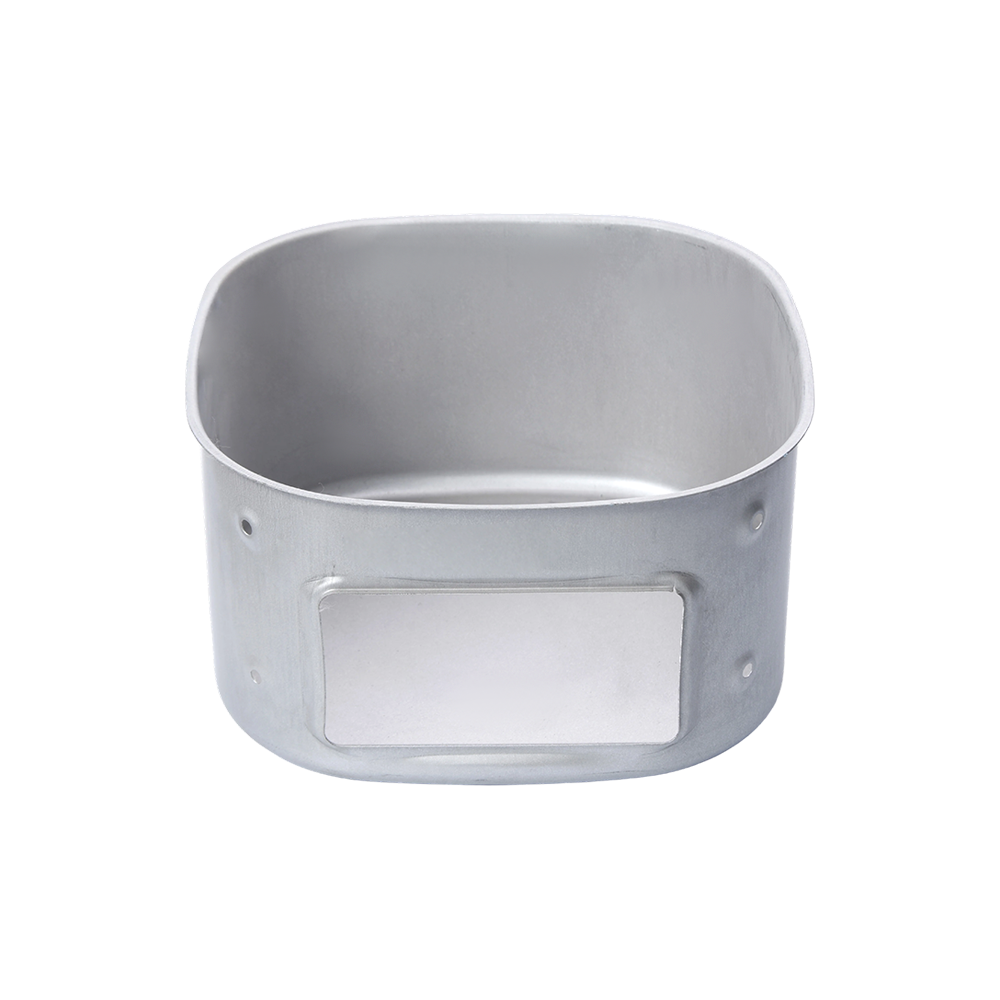
 Deep-Drawn Square ContainerA seamless one-piece deep-drawn container with a space-saving square shape, corrosion resistance, and strength under heavy loads. It is a good example of how deep drawing shapes deeper-than-wide parts without welded seams.View Product →
One Stroke or Many: How the Dies Are Arranged
Simple parts can be completed in a single press stroke with a single-operation die. More complex parts run through a progressive die: the coil advances one station per stroke, and each station cuts or forms a little more until the finished part is separated from the strip at the last station. Deep drawn parts are often produced on transfer systems instead, where individual blanks move between stations so the walls can stretch gradually without tearing. Choosing the right arrangement is one of the biggest cost decisions in any stamping project.
Where Stamped Parts End Up
Once you know what to look for, you will spot stamped components almost everywhere:
- Automotive: brackets, heat shields, and structural sheet metal parts that must survive vibration, heat, and years of service.
- Kitchen appliances: baking trays, containers, base plates, and sink components that need smooth surfaces and precise, repeatable fits.
- Electronics and machinery: chassis panels, covers, and mounting plates that pair thin, light walls with dependable rigidity.
These are the two families that keep our own presses busiest. Automotive stamped sheet metal parts call for tight tolerances and consistent material behavior, while air fryer accessories such as trays and containers call for clean forming and an immaculate finish. The fundamentals you have just read apply equally to both.
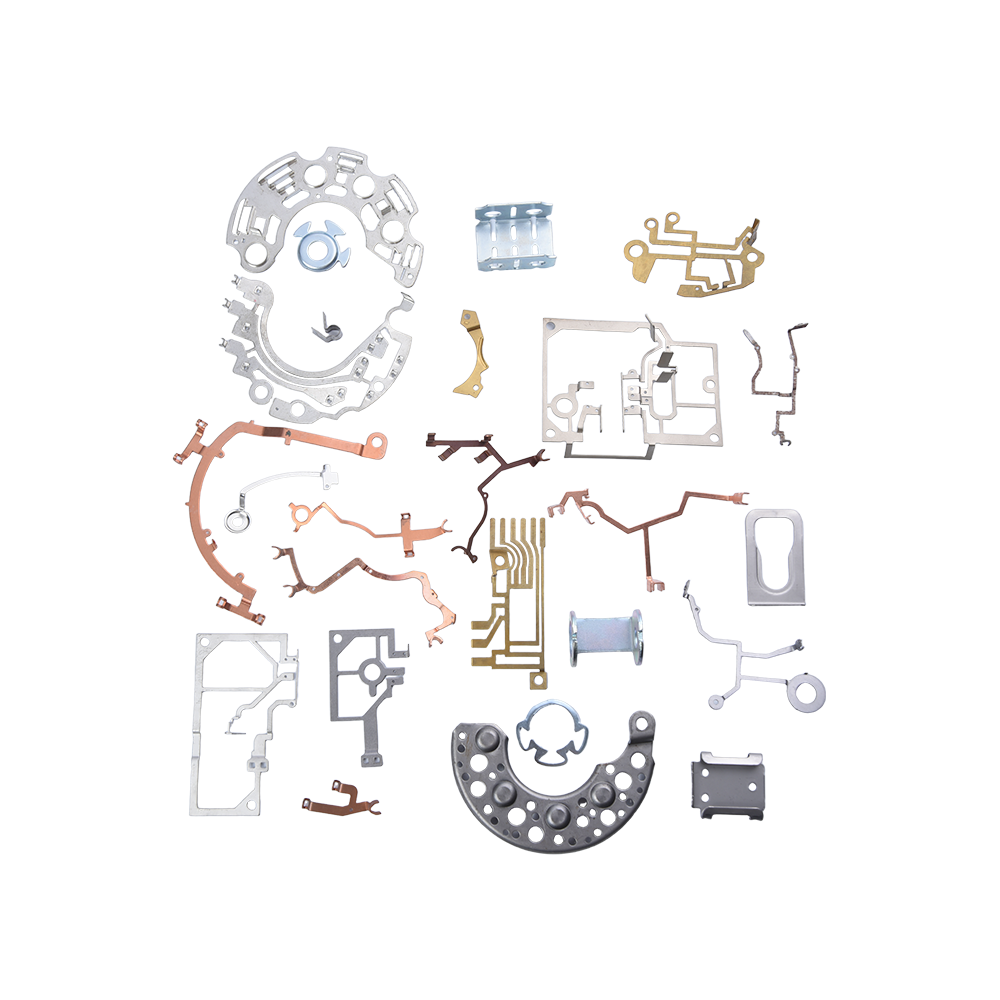 Stamped Sheet Metal Parts for AutomotivePrecision-stamped automotive parts offering accurate dimensions, corrosion resistance, and consistent mechanical strength. They illustrate how the stamping fundamentals described above deliver tight tolerances in demanding vehicle applications.View Product →
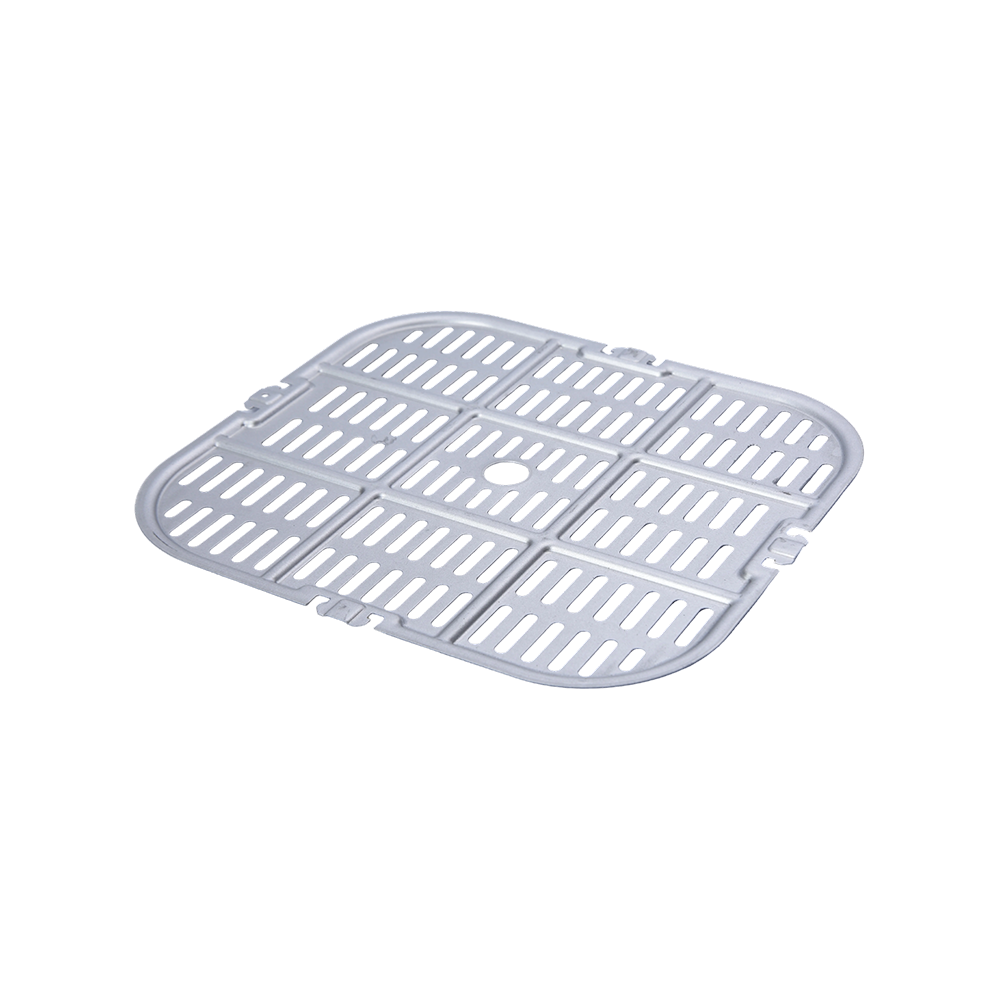 Air Fryer Baking TrayA stamped air fryer accessory with even heat distribution and a perforated surface for crisp results. It shows how clean forming and a fine finish matter when stamping household appliance components.View Product →
Why Manufacturers Choose Stamping
- Speed: once the tooling is proven, each part takes seconds, stroke after stroke.
- Consistency: parts leaving the die are virtually identical, which simplifies assembly downstream.
- Low unit cost at volume: the main investment sits in the die, so cost per piece falls sharply as quantities grow.
- Material efficiency: nesting software arranges parts tightly on the strip to minimize scrap.
- Strength: cold working hardens the metal, so formed areas often end up tougher than the original sheet.
From Coil to Finished Part
That, in essence, is how metal stamping works: a press applies enormous, precisely controlled force through a custom die, and a flat sheet of metal becomes a finished component within seconds. The concept is simple, but dependable results come from sound design advice, well-built tooling, and disciplined inspection at every step. If you are sourcing stamped, bent, or deep drawn parts, our team would be glad to review your drawings and recommend the most efficient way to produce them.
Previous Post
How Do I Find a Reputable Metal Fabricator? A Practical Guide for Buyers
Next Post
How Do You Stamp Metal? A Clear Step-by-Step Guide to Industrial Metal Stamping
News
-
-
Sheet metal bending is one of the most fundamental processes in metal fabrication. It turns a flat sheet of steel, aluminum, or copper into...
READ MORE -
Bend allowance is one of those numbers that quietly determines whether a sheet metal part fits the first time or becomes rework on the shop...
READ MORE -
A flat mounting plate with three punched holes and a rectangular container with a fitted lid can come off presses in the same workshop, yet...
READ MORE
Get Fresh Updates Via Email
We promise we will never disclose your email address, and you can opt out at any time.
-
Quick Links
Home About Us Products Service News Contact Us -
Product list
Deep-drawn parts Stamped parts Bending parts Kitchen appliance accessories Automotive stamping parts -
About Us
Factory Honour FAQ -
News
Company News Industry News -
Contact Us
Address: South side of Shunke Road, Yangming Science and Technology Industrial Park, Yuyao City, Zhejiang Province, China Tel: +86-13905842349/+86-13738485724 Email: hongli@hl-stamping.com
Copyright © Yuyao Hongli Optoelectronics Co., Ltd. All Rights Reserved.
Custom Precision-Sheet/Sheet Metal Stamping Manufacturers
